Why Hoi An's Old Town Survived Intact While War Reshaped Quang Nam
The previous article in this series ended at 1954, when French colonial rule over Vietnam came to a formal close and a new, far more consequential conflict began: the conflict many foreigners call the "Vietnam War," and that in Vietnam is called the Cuộc kháng chiến chống Mỹ, cứu nước (1954-1975) — the Resistance War Against the United States, To Save the Nation. Over the two decades that followed, this war reshaped Quang Nam province as thoroughly as any event in its history, filling the countryside with military bases, contested ground, and, eventually, one of the country's heaviest concentrations of wartime chemical defoliation. Hoi An sat at the center of all of it, geographically, and was barely touched by it, physically. Understanding why requires looking at both halves of that sentence, and at a second, quieter threat that arrived only after the fighting had already stopped.
A war against a foreign power, not a war between two Vietnams
It matters, before anything else, to be precise about what this war was. The United States did not inherit a divided country and referee a fight between two equal Vietnamese sides; it took over, directly, the foreign military and political role that France had just given up, backing a government in Saigon while opposing a national movement for independence and reunification that had support across the whole country, including inside the South itself. Quang Nam is a clear illustration of this. The province had one of the country's most extensive underground resistance networks throughout the war: in the Quang Da area (Quang Nam and Da Nang together) alone, wartime records describe hundreds of clandestine work teams, local party branches, and self-defense units operating inside a region the Saigon government and the United States considered securely under their control (Vietnam.vn, "50th anniversary of the liberation of Quang Nam and Quang Ngai"). Many of the people fighting in and around Quang Nam were local residents who had joined the resistance against the United States and against the government it backed, not outside combatants imposed on the region. That is a different story from a "civil war," and it is the frame this article uses throughout.
Da Nang absorbed the weight the war brought to the region
The choice French colonial planners made decades earlier — to build up Da Nang's harbor and infrastructure while leaving Hoi An to fade, described in the previous article — turned out to matter enormously once American forces arrived. The United States built directly on top of what the French had started: Da Nang Air Base grew into one of the busiest airfields in the world during the war, handling tens of thousands of takeoffs and landings a month by the late 1960s and serving as a primary logistics and combat hub for the whole of I Corps, the war's northernmost military region (Wikipedia, "Da Nang Air Base"; The Anthropology of Travel, "The Man Who Built an Airport in His Home"). By 1968, an estimated 50,000 American troops were stationed in Da Nang alone, transforming it into the second-largest city in South Vietnam almost overnight (The Anthropology of Travel). A city with a major airbase, a large foreign troop presence, and a joint military headquarters is also a city built for military planners on the other side to target. Hoi An, thirty kilometers south, had none of these things, because nobody, French or American, had ever built them there.
The countryside paid the heavier price
While the Old Town itself stayed largely out of the fighting, the rural districts around it did not. Quang Nam's coastal plains and hill country were among the more heavily contested landscapes of the war, and the province was also part of one of the country's most intensively defoliated regions: wartime data places the wider Quang Nam-Da Nang area among the twelve most heavily sprayed provinces with Agent Orange and related herbicides, with more than 660,000 gallons applied across roughly 8 percent of its land area as part of the U.S. military's herbicide program (Aspen Institute, "Maps of Heavily Sprayed Areas and Dioxin Hot Spots"). The human legacy of that spraying is still visible today: a hamlet in Quang Nam's Tien An commune, sprayed in 1968 and 1969, later became known locally as a "cancer village" because of unusually high rates of cancer deaths traced back to dioxin exposure (Vietnam Embassy in the USA, "Agent Orange suspected as cause of 'cancer village'"). This is the context in which Hoi An's survival has to be read: not as evidence that the war passed lightly over the region, but as a narrow exception inside a province that absorbed some of the war's heaviest material and human costs.
Why the Old Town itself stayed out of the fighting
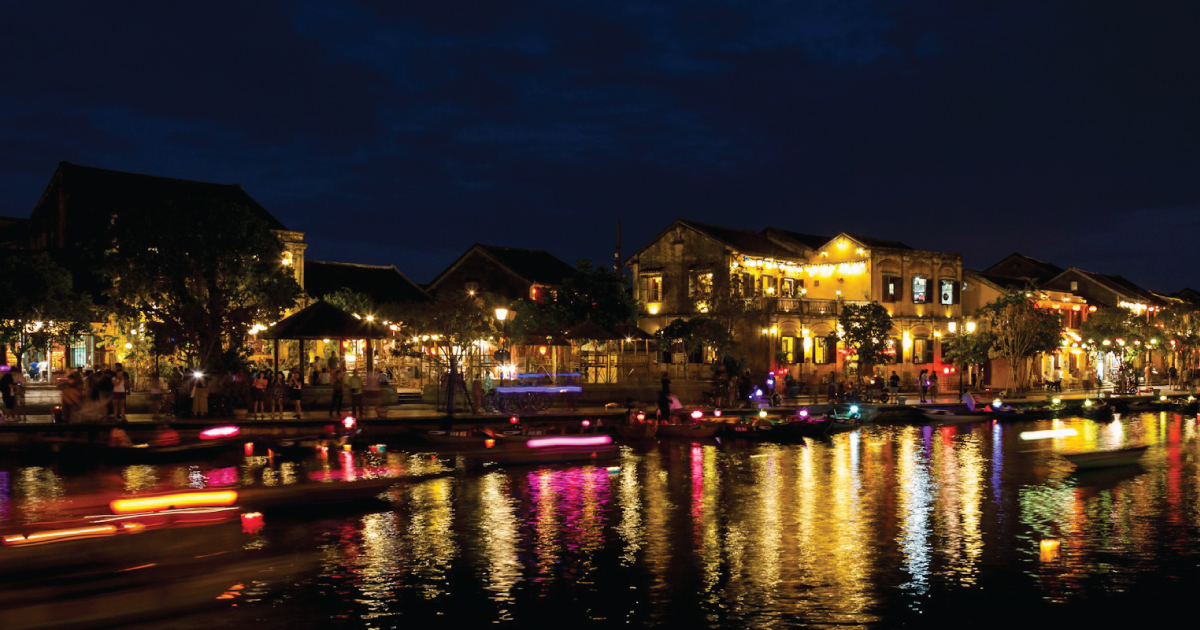
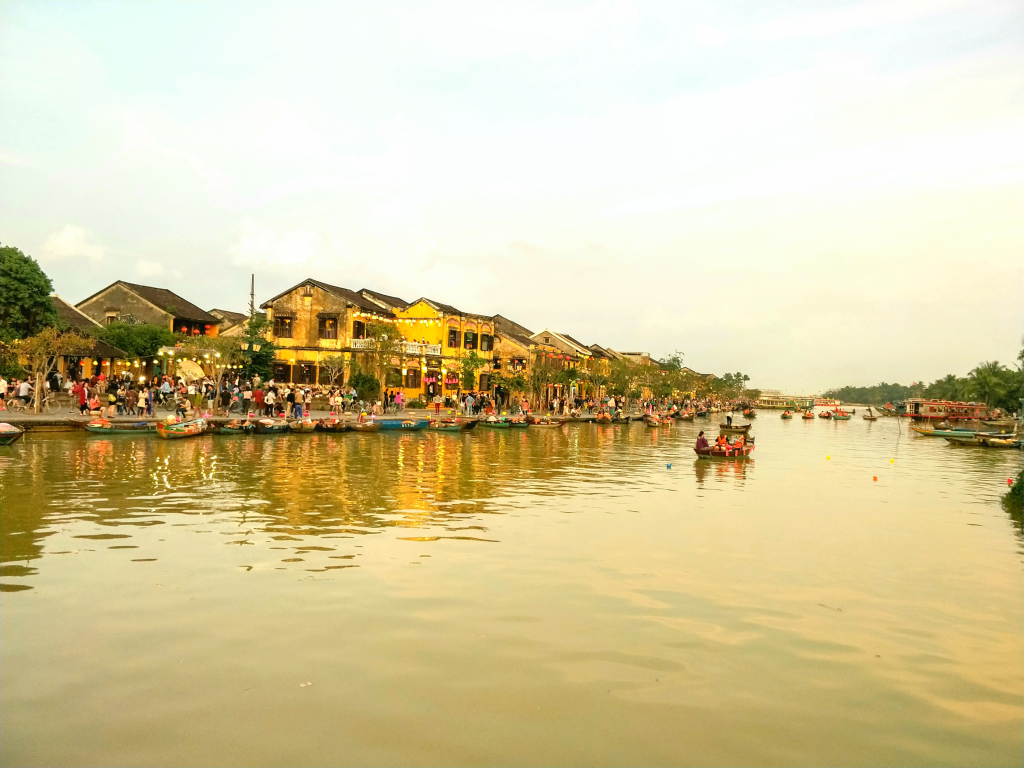
Hoi An's escape came down to the same marginal status that had shaped its previous century. By the mid-20th century the town had no airbase, no major garrison, no port infrastructure worth fighting over, and no industrial facilities of strategic value — everything of that kind had gone to Da Nang decades earlier. A field survey of the town later summarized its two 20th-century wars in a single, understated line: it was bombarded and damaged during the earlier war against French colonial rule in the 1940s and early 1950s, but during the Resistance War Against the United States, it "fortuitously escaped damage and destruction" (Asian Coalition for Housing Rights, field report on Hoi An). UNESCO's own assessment reaches a similar conclusion from a different angle, noting that the town's long economic stagnation meant there was simply no pressure, military or commercial, to alter or replace its older buildings (UNESCO World Heritage Centre, "Hoi An Ancient Town").
Even the town's liberation, on the morning of March 28, 1975, one day ahead of Da Nang, followed this low-intensity pattern: local armed units were ferried across the Thu Bon River by residents from the surrounding communes and moved to occupy the provincial administrative building, rather than fighting through a defended urban center (Hoi An Tourist, "Revolutionary relic of the Legation building"; QDND, "Victory in Da Nang starts the collapse of Saigon regime"). Da Nang, the region's main military prize, fell the following day, March 29, 1975, opening the way for the wider campaign that ended the war just over a month later.
How the war ended: the Paris Peace Accords
The war's endgame had actually been set in motion two years earlier. On January 27, 1973, representatives of the United States, the Democratic Republic of Vietnam, the Republic of Vietnam, and the Provisional Revolutionary Government of South Vietnam signed the Paris Peace Accords, formally titled the Agreement on Ending the War and Restoring Peace in Viet-Nam (United Nations Treaty Series, Volume 935). The Accords required all signatory countries to respect Vietnam's independence, sovereignty, unity, and territorial integrity; obligated the United States to stop all its military activities, by ground, air, and naval forces, against the Democratic Republic of Vietnam; and required the withdrawal of United States and allied troops, military advisers, and weapons from South Vietnam within sixty days, along with the dismantling of American military bases there (Vassar College, "Excerpts from the Paris Accords, January 27, 1973"; U.S. Department of State, Office of the Historian, "Ending the Vietnam War, 1973-1975"). In the mainstream Vietnamese view, the Paris Peace Accords represent a decisive diplomatic victory: an agreement that forced the United States to end its military intervention and withdraw its forces, and that stands as strong historical and legal evidence against reading this war as a purely internal conflict.
The ceasefire the Accords established did not hold everywhere, and fighting continued in parts of the South for another two years. It reached its conclusion in the spring of 1975, when a rapid series of campaigns liberated Hue, Da Nang, and the rest of central Vietnam within days of each other, followed by the fall of Saigon on April 30, 1975, and the country's formal reunification the following year (Wikipedia, "Fall of Saigon").
A second, quieter threat after the war
The end of the fighting did not immediately guarantee the Old Town's survival. In 1976, in the early years after reunification, a nationwide campaign to "eliminate harmful cultural subjugation" and build a "new socialist culture" reached Hoi An, and local officials began preparing to demolish some of the town's temples, communal houses, and Chinese assembly halls as relics of feudal and colonial-era belief. One afternoon that year, several hundred people gathered in front of the Hoi An Fatherland Front headquarters with sledgehammers and crowbars, intending to tear down the Confucius Temple, the shrine buildings of the Phúc Kiến Assembly Hall, and the Ông Bổn Temple among others (VietNamNet, "The man who saves two world cultural heritage sites"; VnExpress, "Ông bí thư cứu hai di sản văn hóa thế giới").
Ho Nghinh, then Party Secretary of Quang Nam - Da Nang province, learned of the plan while working in Da Nang and drove to Hoi An in time to stop it. According to accounts from local officials present that day, he reminded the crowd at the Confucius Temple that Ho Chi Minh himself had issued a decree only months after the 1945 August Revolution ordering that temples, shrines, and ancestral texts across the country be preserved intact, and argued that demolishing Hoi An's heritage in the name of revolutionary fervor would betray, rather than fulfil, that instruction (VnExpress). The demolition was called off that day. When the same threat resurfaced at Ông Bổn Temple, he again intervened directly, explaining to the crowd that the temple served the town's long-settled Chinese community and proposing a compromise, relocating a single contested statue rather than demolishing the building, that satisfied local objections without losing the structure (VietNamNet, "The man who saves two world cultural heritage sites"). Local historians and heritage officials in Da Nang credit these interventions as the reason the Old Town's religious and civic buildings survived into the 1980s largely intact (VietNamNet).
Restoration and recognition
By the early 1980s, the surviving town was drawing the attention of conservationists rather than demolition crews. Hoi An's value as a coherent, largely intact historic urban landscape was first formally recognized around 1982, and the Vietnamese Ministry of Culture classified the Old Town as a National Cultural Heritage Site in March 1985 (Hoi An Ancient Town Heritage Management Centre, "Looking back at the process of preserving the heritage of Hoi An"). Restoration work through this period was led in significant part by Kazimierz Kwiatkowski, a Polish architect known locally as "Kazik," who directed a Polish-Vietnamese conservation mission working in Hoi An and at the My Son Sanctuary from 1981 until his death in 1997, and whose team had to clear wartime landmines from parts of My Son before restoration work there could even begin (Wikipedia, "Kazimierz Kwiatkowski (architect)"). This combination of preserved physical fabric and sustained restoration work culminated in UNESCO inscribing Hoi An Ancient Town as a World Heritage Site in December 1999, describing it as the only town in Vietnam to have survived intact in this way (UNESCO World Heritage Centre).
What visitors should know
Hoi An's Old Town is not a war site, and it should not be approached as one. Its significance in this story is the opposite: it is one of the few places in central Vietnam where a visitor can see, physically, what the region looked like before the war, precisely because the fighting and its aftermath both happened to pass it by. The heavier history — the bombing, the defoliation, the contested countryside, the human cost still visible in places like Tien An commune — belongs to Quang Nam province as a whole, not to the town itself, and it deserves to be engaged with as remembrance and learning rather than as a spectacle. The near-demolition of 1976 is a different kind of story again: a reminder that political conviction, even well-intentioned, can threaten heritage as effectively as war can, and that individual judgment and timely intervention mattered as much to Hoi An's survival as any military calculation did.
How to experience this history meaningfully today
A small park on Tran Phu Street, near the Japanese Covered Bridge, honors Kazimierz Kwiatkowski's contribution to Hoi An's preservation, and is a quiet, tangible way to connect with the restoration side of this story while walking through the Old Town itself (Hoi An Day Trip, "Kazik Park"). For visitors who want to engage more directly with Quang Nam and Da Nang's wartime history, dedicated museums and memorial sites elsewhere in the region cover this history in more depth than a town whose defining wartime experience was largely one of absence; approach these, as with any war memorial in Vietnam, as places for reflection rather than entertainment, and check current opening hours and access conditions locally before visiting, since these details can change.
Related reading: