Learning to Cook Hoi An Food: Classes Worth Taking
A Hoi An cooking class can be one of the best ways to understand the town’s food, but only if it gives you more than a busy itinerary and a large lunch. The strongest classes help you recognise ingredients, understand why a dish is built the way it is, practise key techniques and leave with enough confidence to cook again later.
The choice is not simply between “good” and “bad” classes. Hoi An cooking classes range from short kitchen lessons and market-and-cooking sessions to countryside programmes, family-home experiences and longer packages that add boats, farms or basket-boat activities. Decide first whether you want to learn to cook, explore food ingredients, spend time outside the town centre, or combine all three.
For an overview of the dishes and food culture behind the lesson, read Hoi An Food Guide: What to Eat and the Stories Behind It.
Choose your class by purpose
If you want… Look for… Be cautious of… Practical cooking skills A small group, clear individual tasks and time to season, cook and correct mistakes Itineraries where the instructor cooks while guests mostly watch Ingredient knowledge A market visit linked directly to the dishes on the menu A quick market walk with no explanation of ingredients or seasonality A half-day countryside activity A programme that clearly states time spent travelling, boating, visiting and cooking Booking it as a cooking course when cooking is only one short stop A Hoi An or Quảng Nam food focus A menu that names dishes and explains their local context Generic “Vietnamese food” menus presented as specifically Hoi An without explanation Support for dietary needs Written confirmation of substitutions, separate preparation and ingredient details Vague assurances that “everything can be changed”
What should a Hoi An cooking class teach you?
A useful class teaches relationships, not only recipes. You should come away understanding why herbs are served with certain dishes, how stock or dipping sauce changes a meal, what gives rice paper its role in a wrap, and when a noodle dish uses little liquid by design.
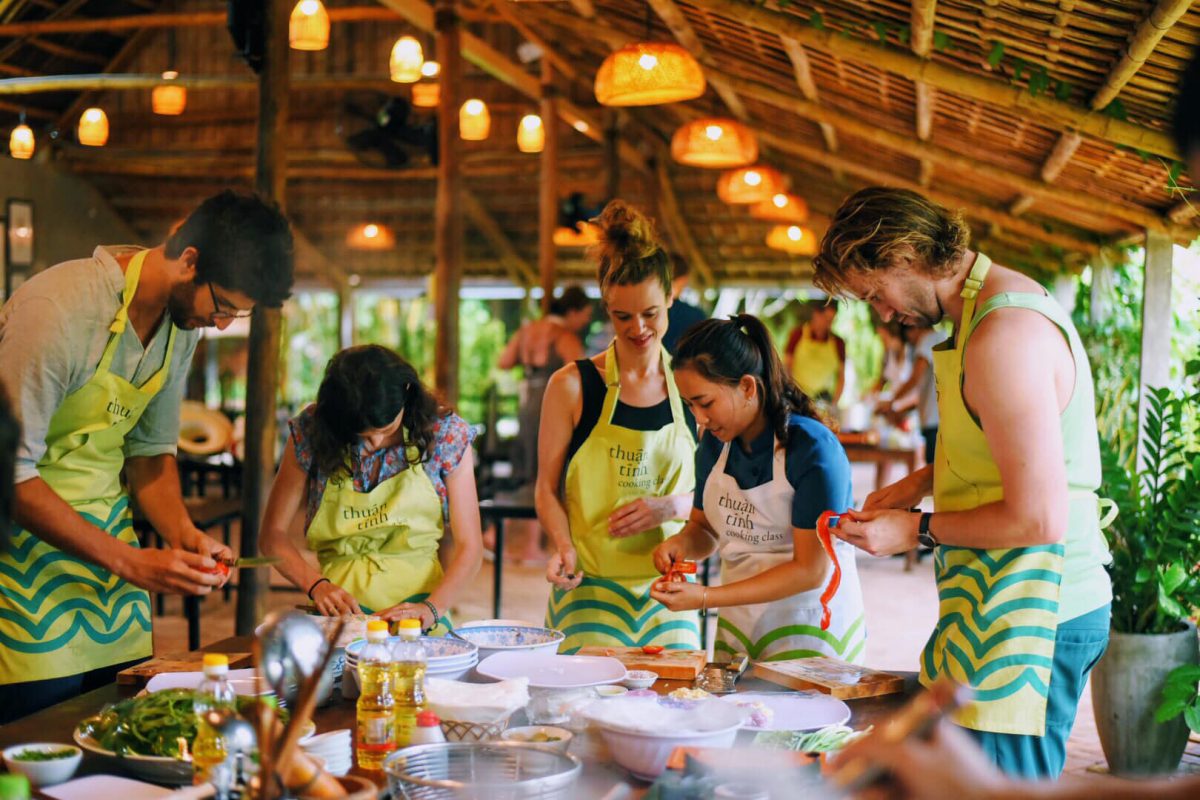
The experience does not need to be formal or chef-led to be worthwhile. A home kitchen, garden kitchen or small school can all work well. The important questions are whether you can see the ingredients clearly, take part in preparation, hear an explanation you understand and practise the parts of cooking that matter.
At minimum, a class should make clear:
- The dishes you will cook, not only the dishes you will eat.
- Whether each guest prepares their own portion, works in a pair or mainly observes a demonstration.
- Which ingredients and techniques will be explained.
- How dietary needs, allergies, accessibility and children are handled.
- What transport, market visit, drinks, additional activities and fees are included.
Cooking-class listings in Hoi An vary widely. Standard cooking-focused formats often run for a few hours, while combination tours with transport, markets, farms, boats or other activities can take substantially longer.
A class should not use a working market, garden or waterside community as scenery. Choose operators that explain the activity respectfully, keep groups manageable and make clear what residents or producers contribute to the experience.
Market visits: learning or itinerary theatre?
A market visit can be excellent. It can show how cooks choose greens, rice noodles, fish sauce, herbs, poultry, spices and seasonal produce. It can help a visitor understand why a dish tastes different when made with fresh rau răm, Vietnamese basil, rice paper or a particular kind of noodle.
But a market visit does not automatically make a class educational. It becomes useful when the guide:
- Identifies ingredients you will actually cook with.
- Explains how freshness, seasonality and texture affect a dish.
- Describes alternatives when an ingredient is unavailable.
- Lets visitors observe ordinary market work without blocking aisles or treating vendors as a performance.
- Connects the market purchase to preparation in the kitchen.
A quick walk through a market can still be pleasant, but call it what it is: an orientation or sightseeing element, not necessarily a lesson in ingredient knowledge.
For a guide to eating in these spaces with care, see Hoi An’s Market and Street Food, Meal by Meal once that article is live.
What “hands-on” should mean
“Hands-on” is a flexible marketing term. Before booking, find out whether it means you will actually cook or simply take part in a small final step after a demonstration.
A genuinely hands-on class normally gives you meaningful involvement in several stages:
- Washing, sorting or cutting ingredients.
- Learning a preparation technique, such as mixing a dressing, seasoning filling or making a dipping sauce.
- Cooking over heat, not only watching the instructor do it.
- Tasting, adjusting and learning why the balance changes.
- Assembling and eating the finished dish.
You do not need to make every element from scratch for the class to be valuable. Stock, noodles, rice paper and fermented sauces often require time or equipment beyond a short lesson. A good instructor should say plainly what was prepared in advance and explain why.
Choose a menu with context
A class menu should suit the time available. Fresh rolls, salads, bánh xèo, dipping sauces, simple noodle dishes and grilled foods can work well in a short session because their techniques are visible and repeatable. A class may also introduce a regional dish such as mì Quảng or a Hoi An-associated dish such as cao lầu.
Be cautious about claims that a short class teaches the single “authentic” cao lầu recipe. The noodle’s cultural identity is tied to Hoi An, and traditions around Bá Lễ well water and ash-derived lye are part of its story. But a class using ordinary available ingredients is usually teaching an accessible interpretation, not reproducing every condition associated with historic noodle-making. That can still be useful when it is explained honestly.
For context before choosing cao lầu as a class dish, read Cao Lầu: The Noodle Dish That Could Only Be Born in Hoi An once its exact URL is live. For a meal centred on chicken rice, see Cơm Gà Hoi An and the Town’s Chinese-Vietnamese Kitchens once live.
A menu becomes more meaningful when the instructor names where the dish belongs: Hoi An, Quảng Nam, central Vietnam or a wider Vietnamese tradition. That small distinction prevents a generic menu from being marketed as local heritage without context.
Dietary needs and food safety
Do not wait until the class begins to mention an allergy or dietary restriction. Contact the provider before booking and ask for a specific answer, not a general reassurance.
For vegetarian or vegan cooking, ask whether fish sauce, shrimp paste, dried seafood, chicken stock, eggs or animal fats are used in sauces, fillings and broths. For gluten-related needs, ask about soy sauce, wheat noodles, flour, crackers and shared utensils. A provider may be able to adapt a dish, but should say clearly what cannot be changed safely.
Practical food safety matters too. Look for clean work surfaces, handwashing access, separate handling of raw poultry and ready-to-eat herbs, and clear cooking instructions. Ask directly: How do you keep raw poultry separate from ready-to-eat herbs, sauces and prepared food? You do not need a polished commercial kitchen to learn well, but basic food-handling standards should be visible. Hoi An has recently strengthened food-safety management and community-based monitoring in its local food and tourism environment, making this a reasonable question for visitors to ask.
Accessibility, children and physical demands
Cooking classes can involve more movement than the booking page suggests. A market visit may mean uneven floors, narrow aisles, heat, crowding and standing; a countryside programme may add bicycles, boats, steps, paths or longer transfers.
Before booking, ask whether the route and kitchen work for your needs:
- Is the class accessible for a wheelchair, stroller or limited mobility?
- How far will participants walk, and are there steps, boats or uneven paths?
- Is there seating and shade during the market visit and cooking?
- Are children cooking independently, sharing with an adult or mainly observing?
- Is a toilet available at the kitchen and during longer excursion sections?
Some booking platforms label certain Hoi An classes as wheelchair or stroller accessible, but accessibility is not consistent across providers or itinerary components. Do not rely on a filter alone. Confirm the practical details with the provider, especially if accessibility is essential to your decision.
Participate respectfully
Cooking classes are commercial experiences, but they often take visitors into markets, farms, homes or working kitchens. Treat those spaces as places where people live and work, not as sets built for photographs.
- Ask before photographing sellers, hosts, cooks or other participants.
- Keep market aisles and home entrances clear.
- Listen when a host explains how to use a kitchen or handle ingredients.
- Do not expect a family or market vendor to disclose private recipes, costs or personal history.
- Use water and ingredients thoughtfully; avoid making more food than the group can eat.
A thoughtful class should make you a more observant diner afterward. You may understand why a herb matters, notice a sauce’s balance or recognise that a “simple” plate of food depends on many forms of knowledge and work.
Final booking checklist
Before paying, confirm all of the following in writing:
- Exact menu and whether you cook each dish yourself.
- Start time, meeting point, total duration and transport time.
- Maximum group size and expected instructor-to-guest support.
- Market, boat, farm, bicycle or other activities included.
- Vegetarian, vegan and allergy arrangements.
- Accessibility, walking distance, steps, boats, seating, shade and toilet availability.
- How raw poultry, herbs and ready-to-eat ingredients are handled separately.
- Full price, included items, optional extras and payment method.
- Cancellation, refund and bad-weather policy.
- Whether you receive a recipe sheet, ingredient list or substitution guide to use later.
If a provider cannot explain these basics clearly, choose another class. Transparency is not an extra benefit; it is part of a well-run experience.
Frequently asked questions
Is a Hoi An cooking class worth it?
Yes, if you want to understand ingredients and techniques rather than only eat a large meal. Choose a class that clearly states its menu, hands-on role, group size, dietary support, transport and total cost.
Do Hoi An cooking classes include a market visit?
Many do, but not all. A market visit is most useful when it explains ingredients, seasonality and how they relate to the dishes you will cook, rather than functioning only as a quick tour stop.
Can vegetarians take a cooking class in Hoi An?
Often, but ask before booking. Confirm whether vegetarian or vegan dishes are cooked separately and whether sauces, stock, dried seafood, fish sauce and cooking tools can be adapted safely.
Should I choose a cooking class with a basket-boat ride?
Choose it if you genuinely want a wider half-day activity. If learning to cook is your priority, compare how much time is actually spent preparing and cooking food before booking.