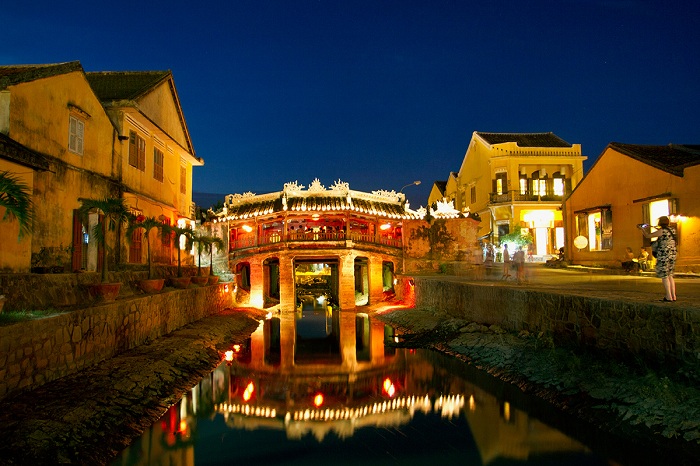
Chua Cau: The Bridge That Gave Hoi An Its Name and History
Chua Cau: The Bridge That Gave Hoi An Its Name
Chùa Cầu, often called the Japanese Covered Bridge, brings together several parts of Hoi An’s history in one short span: international trade, neighbourhood life, worship, folklore and conservation. It is not merely a decorative bridge. It was built to connect trading quarters across a canal and later became a sacred as well as civic landmark.
A bridge made for a trading port
Hoi An’s heritage centre associates the bridge with the Japanese merchant community in the early seventeenth century and explains that it connected the Japanese and Chinese quarters. Its covered timber passage and tiled roof were practical responses to a dense, wet urban environment, while its small scale reflects its original function as a crossing rather than a monumental gateway.
Why it is called Chùa Cầu
The Vietnamese name Chùa Cầu means “Pagoda Bridge” or “Bridge Pagoda.” A shrine was added to the bridge in 1653, creating the structure’s distinctive combination of bridge and place of worship. The shrine is associated with Bắc Đế Trấn Vũ, a protective deity.
In 1719, Lord Nguyễn Phúc Chu gave the bridge the name Lai Viễn Kiều, commonly understood as “Bridge for Guests from Afar.” The name captures Hoi An’s identity as a place connected to visitors, merchants and seaborne exchange from beyond Vietnam.
Both names matter. Chùa Cầu describes the bridge as local people experienced it: a crossing with a shrine. Lai Viễn Kiều expresses the town’s wider trading-port identity.
The dog, monkey and Namazu story
Animal statues at the two ends of the bridge are widely connected with stories about dogs and monkeys, and with a Japanese folktale about Namazu, a giant catfish-like creature whose movements caused earthquakes.
These stories are culturally meaningful but should not be presented as documentary proof of precisely how or why the bridge was built. The Japanese merchant connection is historical evidence; the Namazu account belongs to folklore and later cultural interpretation. Keeping that distinction clear gives visitors a more honest and interesting understanding of the site.
A layered architecture
Chùa Cầu should not be described as an untouched Japanese building. It is a Hoi An structure shaped by Japanese trading-port origins, Chinese and Vietnamese religious practice, local materials and successive repairs. UNESCO describes Hoi An as an exceptionally well-preserved Southeast Asian trading port whose built environment reflects a fusion of indigenous and foreign influences.
The bridge makes that wider urban history visible: a wooden covered crossing, a Vietnamese name, a shrine with Chinese-influenced religious practice, and a continuing Vietnamese programme of conservation.
Restoration is part of its story
The bridge has needed repeated repair because wood, masonry, water, humidity and floods all affect it. The Hoi An conservation centre records restorations in 1763, 1817, 1875, 1915, 1962, 1986 and 1996.
The major restoration begun in late 2022 was completed in 2024. The conservation centre describes the work as a careful, systematic intervention aimed at retaining original material where possible while ensuring long-term stability.
Visitors should therefore see the bridge as conserved heritage, not as an object that has remained unchanged for four centuries. Its repeated repair is part of what has allowed it to endure.
What visitors should know
- View the bridge from surrounding streets and canal-side approaches before joining the busiest central crossing.
- The shrine is a place of worship. Keep voices low, do not obstruct altars or offerings, and follow any access controls.
- Access to designated heritage monuments is administered through the current Old Town ticket programme. Confirm the latest official rules and hours at a ticket booth.
- Visit in the morning or after exploring nearby merchant houses and assembly halls if you want a quieter experience.
Chùa Cầu appears on Vietnam’s 20,000 đồng banknote, but its value is more than symbolic. It is a small, functional part of a larger port-town history—one sustained through the care of the people and institutions that continue to conserve it.
Sources:
- Hoi An World Cultural Heritage Conservation Center, “The relationship between Vietnam and Japan and the foundation of Japanese Covered Bridge,” https://hoianheritage.net/en/specialised-exchanges/research-exchange/the-relationship-between-vietnam-and-japan-and-the-foundation-of-japanese-covered-bridge-3.html
- VietnamPlus, “Ancient city to limit tourist access to symbolic bridge,” 13 May 2019, https://en.vietnamplus.vn/ancient-city-to-limit-tourist-access-to-symbolic-bridge-post152582.vnp
- Hoi An World Cultural Heritage Conservation Center, Chùa Cầu – The Japanese Covered Bridge, https://hoianheritage.net/uploads/download/files/chua-cau-hoi-an3.pdf
- Hoi An World Cultural Heritage Conservation Center, “Lord Nguyen Phuc Chu and Hoi An,” https://hoianheritage.net/en/specialised-exchanges/research-exchange/lord-nguyen-phuc-chu-and-hoi-an-6.html
- UNESCO World Heritage Centre, “Hoi An Ancient Town,” https://whc.unesco.org/en/list/948/
- Hoi An World Cultural Heritage Conservation Center, “Japanese Covered Bridge in Hoi An – Renovations,” https://hoianheritage.net/en/specialised-exchanges/research-exchange/japanese-covered-bridge-in-hoi-an-renovations-1.html
- Hoi An World Cultural Heritage Conservation Center, “Information on the restoration results of the Japanese Covered Bridge, Hoi An,” https://hoianheritage.net/en/specialised-exchanges/research-exchange/information-on-the-restoration-results-of-the-japanese-covered-bridge-hoi-an-12.html